Independent Advisory Board for Supreme Court of Canada Judicial Appointments - Report on 2026 Process
July 30, 2026
The Right Honourable Mark Carney, P.C., M.P.
Prime Minister of Canada
80 Wellington Street
Ottawa, Ontario
K1A 0A2
Dear Prime Minister:
Pursuant to our Terms of Reference, the Independent Advisory Board for Supreme Court of Canada Judicial Appointments submits this report on the 2026 process, including information on the mandate and the costs of the Advisory Board’s activities, statistics relating to the applications received, and recommendations for improvements to the process.
We thank you for the opportunity to serve on the Advisory Board and to participate in such an important process.
Yours very truly,

Maureen A. McTeer, O.C.
Chairperson, Independent Advisory Board for Supreme Court of Canada Judicial Appointments
Advisory Board members:
Riel Francis Bellegarde
Marie-Pierre Lavoie
Justin E. Kingston
Justin Robichaud, K.C.
The Honourable J. Michael MacDonald, CM, ONS
Laura M. Spitz
Aimée Craft, O.Ont.
Table of Contents
- Introduction
- Establishment of the Advisory Board and the 2026 Process
- Meetings of the Advisory Board and Application Review Process
- Communications, Media and Public Affairs
- Consultation and Outreach
- Applications
- Costs
- Recommendations on Improvements to the Appointments Process and Work of the Advisory Board
- Confidentiality
- Conclusion
- Annex A: Terms of Reference for the Advisory Board
- Annex B: News Release, dated March 30, 2026, from the Office of the Prime Minister of Canada
- Annex C: News Release, dated May 19, 2026, from the Office of the Prime Minister of Canada
- Annex D: Biographical Notes on the Members of the Advisory Board
- Annex E: Qualifications and Assessment Criteria
- Annex F: Functional Bilingualism and the Supreme Court of Canada Judicial Appointments Process
- Annex G: Outreach letter sent to Organizations
1. Introduction
This report has been prepared by the Independent Advisory Board for Supreme Court of Canada Judicial Appointments (“Advisory Board” or “Board”) pursuant to paragraph 12 of the Terms of Reference (Annex A) which states:
12 (1) Within one month after a judge is appointed, the Advisory Board must submit a report, in both official languages, to the Prime Minister that contains information on the carrying out of the mandate, the costs relating to the Advisory Board’s activities and the statistics relating to the applications received.
(2) The report may also contain recommendations for improvements to the process.
(3) The report must be made public.
This report covers all the above enumerated stipulations, including information on the carrying out of the mandate, costs related to the Advisory Board’s activities, and statistics relating to applications received. At the end of the report is a series of recommendations for improvements to the process.
2. Establishment of the Advisory Board and the 2026 Process
The Advisory Board is an independent and non-partisan body whose mandate is to provide non-binding, merit-based recommendations to the Prime Minister on judicial appointments to the Supreme Court of Canada (SCC). The Advisory Board is convened at the discretion and request of the Prime Minister. The Board was previously called upon in 2016, 2017, 2019, 2021, 2022 and 2023, resulting in the appointments of Justices Malcolm Rowe, Sheilah Martin, Nicholas Kasirer, Mahmud Jamal, Michelle O’Bonsawin and Mary Moreau.
The composition of the Advisory Board is as follows:
- Three members, at least two of whom are not advocates or barristers in a province or territory, nominated by the Minister of Justice;
- A practising member in good standing of the bar of a province or territory, nominated by the Canadian Bar Association;
- A practising member in good standing of the bar of a province or territory, nominated by the Federation of Law Societies of Canada;
- A practising member in good standing of the bar of a province or territory, nominated by the Indigenous Bar Association;
- A retired superior court judge, nominated by the Canadian Judicial Council; and
- A legal scholar, nominated by the Council of Canadian Law Deans.
The composition of the Advisory Board was amended for the 2022 process to include a practising member in good standing of the bar of a province or territory nominated by the Indigenous Bar Association.
The 2026 process was launched by the Prime Minister on March 30, 2026, in order to fill the seat on the Supreme Court of Canada created by the retirement of the Honourable Sheilah Martin. Justice Martin was appointed to the Supreme Court of Canada from the Court of Appeal of Alberta. In recognition of the convention of regional representation, the process was open to all qualified candidates from Western Canada and Northern Canada, that is British Columbia, Alberta, Saskatchewan, Manitoba, Nunavut, Yukon and the Northwest Territories. Candidates who wished to be considered were required to complete and submit applications by April 27, 2026 (Annex B).
Advisory Board members were appointed May 13, 2026. A News Release announced the appointments May 19, 2026 (Annex C). The members of the Advisory Board are:
- Maureen A. McTeer, O.C., Chairperson, nominated by the Minister of Justice;
- Riel Francis Bellegarde, nominated by the Minister of Justice;
- Marie-Pierre Lavoie, nominated by the Minister of Justice;
- Justin E. Kingston, nominated by the Canadian Bar Association;
- Justin Robichaud, K.C., nominated by the Federation of Law Societies of Canada;
- The Honourable J. Michael MacDonald, CM, ONS, nominated by the Canadian Judicial Council;
- Laura M. Spitz, nominated by the Council of Canadian Law Deans; and,
- Aimée Craft, O. Ont., nominated by the Indigenous Bar Association.
Full biographical notes on the members of the Advisory Board can be found at Annex D.
The Prime Minister asked that the Advisory Board submit for his consideration a short list of qualified and functionally bilingual candidates. Candidates were required to demonstrate that they satisfy the geographical requirement by reference to their bar membership, judicial appointment, or other relationship with Western Canada or Northern Canada.
As noted in the Terms of Reference, the Advisory Board is supported by the Office of the Commissioner for Federal Judicial Affairs Canada (FJA), and its Commissioner, or his or her delegate, acts as the ex officio secretary to the Advisory Board. FJA is also responsible for administering the application process, including assessing whether a candidate is functionally bilingual.
Detailed information concerning the process, the mandate of the Advisory Board and instructions on how to apply for appointment to the Supreme Court of Canada was made available on FJA’s website at www.fja-cmf.gc.ca immediately following the opening of the 2026 process.
3. Meetings of the Advisory Board and Application Review Process
Immediately upon appointment on May 13, 2026, each member of the Advisory Board reviewed all applications individually. The Advisory Board then met in Ottawa May 20 to 23, along with the Commissioner and the ex officio secretary to the Board, to carry out its mandate.
While in Ottawa, the Advisory Board also met with the Chief Justice of Canada to hear his views on the needs of the Court. The meeting also provided valuable insight into the work of the Court and its Justices, which benefited the Advisory Board in conducting its assessments of candidates.
Based on the initial review of the applications and discussions as to who met the established criteria and qualifications, the Advisory Board deliberated and decided which candidates it would like to interview. The Advisory Board proceeded to conduct phone interviews with the references for those candidates. References were asked the same set of questions, in order to be fair to candidates and to allow for comparability between them. Members then debriefed each other on each reference call they had made. The candidates to be interviewed were contacted, and interview times were scheduled.
Interviews with four candidates were conducted in person on May 23, 2026. The candidates were engaged in a comprehensive discussion in response to a set series of questions designed to help the Advisory Board assess fully and fairly the candidates’ qualifications in relation to the assessment criteria, which had been published with the application instructions. (Annex E).
Immediately following the interviews, FJA language experts conducted a second-language proficiency assessment for each candidate, using assessment tools and rating grids to determine whether candidates met the functional bilingualism requirements for reading, listening and speaking. Results were communicated to the Advisory Board members. A description of the functional bilingualism process is included in Annex F.
The Advisory Board then deliberated to decide which candidates it would recommend to the Prime Minister, and to write its “short list” report to him. The Advisory Board ultimately submitted to the Prime Minister a list of two exceptional candidates. The Advisory Board was very impressed with the credentials of the two candidates, and was unanimous in its view, confirmed by the references, that both candidates exemplify what the government seeks in the professional and personal qualities of an appointee to the Supreme Court of Canada. The two candidates’ experience and expertise also meet all the Court’s current institutional needs. The recommended candidates were not prioritized and were listed in alphabetical order. The report provided an assessment of how each of the recommended candidates meets the requirements of the Supreme Court Act, and the extent to which they meet the assessment criteria established by the Prime Minister, as well as any additional reasons in support of their candidacy.
The Report was submitted to the Prime Minister’s Office on June 1, 2026. The Prime Minister made the appointment from the list of candidates submitted to him.
4. Communications, Media and Public Affairs
As indicated above, the process was launched on March 30, 2026, with a News Release from the Prime Minister.
On the same date, FJA published on its website information on the Advisory Board’s Terms of Reference, the application process, qualifications and assessment criteria, frequently asked questions, and relevant contact persons.
On May 19, 2026, the Prime Minister announced the appointment of the Advisory Board chaired by Maureen A. McTeer, O.C.
The creation of the Advisory Board and the launch of the application process generated some media interest (print, online, radio, television), much of it consisting in speculation and opinion on who should be appointed and some comments on the process. The nomination on June 22, 2026, of the Honourable Glenn D. Joyal elicited a great deal of media attention.
In the realm of public affairs and government engagement, the Chair of the Advisory Board appeared with the Minister of Justice and the Commissioner before the House of Commons Standing Committee on Justice and Human Rights on June 29, 2026. In addition, a public question and answer session was held with the Honourable Glenn D. Joyal on the same day. These appearances generated considerable media interest.
5. Consultation and Outreach
As discussed above, before beginning its deliberations, the Advisory Board met with the Chief Justice of Canada to obtain his views on current challenges and needs of the Supreme Court and its judges.
On behalf of the Advisory Board, in accordance with its mandate to conduct outreach efforts and prior to the appointment of its members, the Commissioner communicated on March 31, 2026, with 73 Canadian legal and judicial organizations, asking them to use their networks and knowledge of the judiciary and legal community in their jurisdictions in order to identify qualified candidates and encourage them to submit an application.
The list of organizations consulted is as follows:
- Akitsiraq Law School
- Alberta Bar Association
- Arab Canadian Lawyers Association (part of RODA*)
- Association des Francophones du Nunavut
- Association des juristes d’expression française de la Colombie-Britannique
- Association des juristes d’expression française de la Saskatchewan
- Association des juristes d’expression française de l’Alberta
- Association des juristes d’expression française du Manitoba
- Association Franco-Yukonnaise
- Association of Justice Counsel
- Avocats sans frontières Canada
- Black Females Lawyer Network
- Black Law Students Association of Canada
- Canadian Association of Black Lawyers (part of RODA*)
- Canadian Association of Crown Counsel
- Canadian Association of Law Teachers
- Canadian Association of Provincial Court Judges
- Canadian Association of Refugee Lawyers
- Canadian Association of South Asian Lawyers
- Canadian Bar Association
- Canadian Bar Association – Equality Committee
- Canadian Council of Criminal Defence Lawyers
- Canadian Criminal Lawyers Association
- Canadian Environmental Law Association
- Canadian Hispanic Bar Association (part of RODA*)
- Canadian Italian Advocates Organization (part of RODA*)
- Canadian Judicial Council
- Canadian Muslim Lawyers Association (part of RODA*)
- Canadian Prison Law Association
- Canadian Superior Courts Judges Association
- Community Legal Assistance Society
- Council of Canadian Law Deans
- EcoJustice
- Family Lawyers’ Association
- Fédération des associations de juristes d’expression française de common law inc.
- Federation of Asian Canadian Lawyers (part of RODA*)
- Federation of Asian Canadian Lawyers (British Columbia) Society
- Federation of Law Societies of Canada
- Hellenic Canadian Lawyers Association (part of RODA*)
- Indigenous Bar Association
- Indigenous Community Legal Clinic (British Columbia)
- Iranian Canadian Legal Professionals (part of RODA*)
- Korean Canadian Lawyers Association (part of RODA*)
- Lakehead University, Bora Laskin Faculty of Law
- Law Society of Alberta
- Law Society of British Columbia
- Law Society of Manitoba
- Law Society of Nunavut
- Law Society of Saskatchewan
- Law Society of the Northwest Territories
- Law Society of Yukon
- Legal Aid Manitoba
- Legal Leaders for Diversity
- Macedonian Canadian Lawyers Association (part of RODA*)
- Manitoba Bar Association
- Northwest Territories Bar Association
- Nunavut Bar Association
- OBA Equality Committee (part of RODA*)
- Pro Bono Canada
- Saskatchewan Bar Association
- South Asian Bar Association of Toronto
- South Asian Legal Clinic of BC (British Columbia)
- The Advocates’ Society
- Thompson Rivers University, Faculty of Law
- Ukrainian-Canadian Bar Association
- University of Alberta, Faculty of Law
- University of British Columbia, Peter A. Allard School of Law
- University of Calgary, Faculty of Law
- University of Manitoba - Robson Hall Faculty of Law
- University of Saskatchewan, Faculty of Law
- University of Victoria, Faculty of Law
- Women’s Legal Education and Action Fund
- Yukon Bar Association
* Roundtable of Diversity Associations (RODA)
The letter sent to the organizations is included in Annex G.
6. Applications
While the above-noted organizations were consulted and encouraged to share the call for applications with their memberships, individuals seeking appointment to the Supreme Court of Canada had to personally complete and submit an application form, which required them to provide their education and employment history as well as list all their publications, judgments and conference participation, as applicable. Candidates were also required to provide answers to a number of essay questions. This information was used to confirm their eligibility for appointment, as well as to help the Advisory Board assess merit, based on the published assessment criteria.
The application period was open from March 30, 2026, to April 27, 2026, a period of four weeks. Qualified candidates from Western Canada and Northern Canada were eligible to apply. The applications were received by email and processed by staff in the Office of the Commissioner.
The Advisory Board received nine applications.
In terms of information on diversity, generated from self-identification by applicants on their application forms, the following data was obtained from the nine applications received:
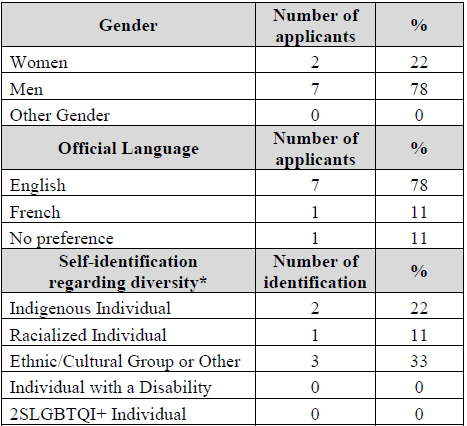
*Some applicants identified in more than one category.
7. Costs
While some expenses and operational costs are still being received and tabulated, it is estimated that the expenditures related to the Advisory Board for this appointment process will be approximately $190,000. Expenses relate to per diems for Advisory Board members, and costs incurred by FJA to support the Advisory Board, including costs related to supplementary salaries, professional services, translation, IT, telecommunications and supplies.
8. Recommendations on Improvements to the Appointments Process and Work of the Advisory Board
The Advisory Board offers the following recommendations for improvement to the process:
- Consultation and Outreach. The Advisory Board reiterates the importance of outreach initiatives designed to encourage applications from highly qualified candidates.
- Diversity. In carrying out its mandate, the Advisory Board was guided by criteria which included that the Supreme Court reflect the broad diversity of members of Canadian society, including, for example, gender-balance, Indigenous peoples, persons with disabilities and members of linguistic, ethnic and other minority communities including those whose members’ gender identity or sexual orientation differs from that of the majority. The Advisory Board recommends that this approach remain an operative principle for future selection boards.
- Appointment of Advisory Board members. The Advisory Board, including its Chair, was appointed on May 13, 2026, more than two weeks after the period for submitting applications had already closed. The Board conducted its work immediately upon appointment and very efficiently, submitting its short list report to the Prime Minister in a timely manner. As indicated in previous processes, the Advisory Board recommends that its members be appointed earlier and as soon as possible in order to avoid any delays in appointments to the Supreme Court of Canada, and in order to fulfill its role in helping to identify potential candidates. It is also strongly recommended that the Chair of the Independent Advisory Board be appointed and announced at the beginning of the process in the future.
- Office of the Commissioner for Federal Judicial Affairs. The Advisory Board notes that this process for recommending nominees has been used seven times since 2016 and that the appointment of the Honourable Glenn D. Joyal to the Supreme Court is the 13th in the last 15 years. The executive, administrative and technological assistance provided to the Advisory Board by the Office of the Commissioner for Federal Judicial Affairs was invaluable and considerable, and the Advisory Board is very grateful to the employees for the work they undertook.
- Application Questionnaire. The Advisory Board recommends the development of a fully bilingual application questionnaire, rather than separate English and French versions. A single bilingual questionnaire would facilitate consistency across applications, simplify the application process for candidates who work in both official languages, and reinforce the commitment to linguistic duality that is fundamental to Canada’s constitutional framework and to the work of the Supreme Court of Canada.
9. Confidentiality
Pursuant to paragraph 11(1) of the Terms of Reference, each Advisory Board member signed an undertaking to respect the confidentiality of the process. Similarly, pursuant to paragraph 11(2) of the Terms of Reference, any “personal information provided to, and deliberations of, the Advisory Board are confidential and must be treated in a manner consistent with the provisions of the Privacy Act.” Furthermore, paragraph 11(3) articulates that Advisory Board members “must keep confidential any information brought before them in the performance of their functions.”
Therefore, the Advisory Board will not share any information pertaining to candidates.
10. Conclusion
The Advisory Board greatly appreciates the opportunity to serve the Prime Minister and all Canadians on such an important initiative. The process was illuminating and highlighted the exemplary jurists, academics and lawyers in Canada who applied for consideration under this process.
Annex A: Terms of Reference for the Advisory Board
Mandate
1 The Independent Advisory Board for Supreme Court of Canada Judicial Appointments (“Advisory Board”) is an independent and non-partisan body whose mandate is to provide non-binding, merit-based recommendations to the Prime Minister on judicial appointments to the Supreme Court of Canada
Composition of the Advisory Board
2 (1) Advisory Board members are appointed during pleasure under paragraph 127.1(1)(c) of the Public Service Employment Act as special advisers to the Prime Minister.
(2) The Advisory Board is to consist of
(a) three members, at least two of whom are not advocates or barristers in a province or territory, nominated by the Minister of Justice;
(b) a practising member in good standing of the bar of a province or territory, nominated by the Canadian Bar Association;
(c) a practising member in good standing of the bar of a province or territory, nominated by the Federation of Law Societies of Canada;
(d) a practising member in good standing of the bar of a province or territory, nominated by the Indigenous Bar Association;
(e) a retired superior court judge, nominated by the Canadian Judicial Council; and
(f) a legal scholar, nominated by the Council of Canadian Law Deans.
(3) The Governor in Council is to designate one of the members to be the Chairperson of the Advisory Board.
Length of Terms
3 (1) Advisory Board members are to be appointed for terms of up to five years, which terms may be renewed for one or more further terms.
(2) The Advisory Board is to be convened at the discretion and at the request of the Prime Minister.
Support
4 The Office of the Commissioner for Federal Judicial Affairs is to provide support to the Advisory Board and will be responsible for administering the application process.
5 The Commissioner for Federal Judicial Affairs, or his or her delegate, is to act as an ex officio secretary to the Advisory Board.
Recommendations
6 (1) In accordance with this mandate, the Advisory Board must submit to the Prime Minister for his or her consideration, within the time period specified by the Prime Minister on the convening of the Advisory Board, the names of at least three, but up to five, qualified and functionally bilingual candidates for each judicial vacancy for which the Advisory Board is convened.
(2) The Advisory Board must provide an assessment of how each of those candidates meets the requirements of the Supreme Court Act and the extent to which they meet the criteria established by the Prime Minister, and any additional reasons in support of their candidacy.
7 The Prime Minister may request that the Advisory Board provide names of additional qualified candidates who are functionally bilingual.
Recommendation Process
8 Advisory Board members must
(a) at all times, observe the highest standards of impartiality, integrity and objectivity in their consideration of all candidates;
(b) review applications received from candidates and actively seek out qualified candidates;
(c) meet as required to assess candidates and engage in deliberations;
(d) be guided by the criteria established by the Prime Minister;
(e) consult with the Chief Justice of Canada and any key stakeholders that the members consider appropriate;
(f) in establishing a list of qualified candidates, seek to support the Government of Canada’s intent to achieve a gender-balanced Supreme Court of Canada that also reflects the diversity of members of Canadian society, including Indigenous peoples, persons with disabilities and members of linguistic, ethnic and other minority communities including those whose members’ gender identity or sexual orientation differs from that of the majority; and
(g) comply with the Conflict of Interest Act and the Ethical and Political Activity Guidelines for Public Office Holders.
9 (1) Advisory Board members must declare to the other members any direct or indirect personal interest or professional or business relationship in relation to any candidate, including any gift or other advantage received by the members from the candidate.
(2) If such a declaration is made, the Advisory Board must decide, having regard to the nature of the interest or relationship, whether the member must withdraw from any deliberations about the candidate.
(3) If the Advisory Board decides that the member must withdraw from any deliberations about a candidate, those deliberations are undertaken by the remaining Advisory Board members, provided the number of remaining members is not less than four.
10 Advisory Board members may travel for the purpose of carrying out their mandate.
Confidentiality
11 (1) Advisory Board members must sign a confidentiality agreement as a precondition of their appointment.
(2) Personal information provided to, and deliberations of, the Advisory Board are confidential and must be treated in a manner consistent with the provisions of the Privacy Act.
(3) Advisory Board members must keep confidential any information brought before them in the performance of their functions.
Reporting
12 (1) Within one month after a judge is appointed, the Advisory Board must submit a report, in both official languages, to the Prime Minister that contains information on the carrying out of the mandate, the costs relating to the Advisory Board’s activities and the statistics relating to the applications received.
(2) The report may also contain recommendations for improvements to the process.
(3) The report must be made public.
Restriction
13 A member of the Advisory Board is not eligible to be considered for a federal judicial appointment for a period of one year after the day on which they cease to be a member of the Advisory Board.
Annex B: News Release, dated March 30, 2026, from the Office of the Prime Minister of Canada
Prime Minister Carney launches process to select the next judge of the Supreme Court of Canada
Ottawa, Ontario
March 30, 2026
Today, the Prime Minister, Mark Carney, launched the process to select the next judge of the Supreme Court of Canada, who will fill the vacancy created by the upcoming retirement of Justice Sheilah L. Martin. Applications from qualified candidates will be accepted until Monday, April 27, 2026.
A non-partisan Independent Advisory Board for Supreme Court of Canada Judicial Appointments will be given the task of identifying suitable candidates who are jurists of the highest calibre, functionally bilingual, and representative of the diversity of our country. After the application period closes, the Advisory Board will review applications and submit a shortlist of highly qualified candidates to the Prime Minister for consideration.
The Prime Minister thanks Justice Martin for her leadership, excellence, and dedication on Canada’s highest court. She was appointed to the Supreme Court of Canada in 2017 and previously served on the Court of Appeal of Alberta, as well as the courts of appeal of the Northwest Territories and Nunavut. In recognition of the convention of regional representation, the process will be open to all qualified applicants from Western Canada and Northern Canada.
Quote
“The Supreme Court of Canada is a pillar of our democracy. As Canada’s highest judicial body, the court – and the judges who serve on it – carry profound responsibilities and the values of integrity, independence, and the rule of law. This process will ensure the high standards that responsibility demands.”
– The Rt. Hon. Mark Carney, Prime Minister of Canada
Quick Facts
- Qualified candidates who wish to be considered for the upcoming vacancy must submit an application package no later than 23:59 Pacific Daylight Time on Monday, April 27, 2026.
- Those interested in applying are encouraged to first review the statutory requirements set out in the Supreme Court Act, and the qualifications and assessment criteria that will guide the Advisory Board in evaluating a candidate’s suitability.
- Candidates may demonstrate that they satisfy the geographical requirement by reference to their bar membership, judicial appointment, or other relationship with Western Canada (British Columbia, Alberta, Saskatchewan, and Manitoba) and Northern Canada (Yukon, Northwest Territories, and Nunavut).
- The Supreme Court of Canada consists of nine judges, including a Chief Justice. They are all appointed by the Governor in Council and must have been either a judge of a superior court or a member of at least 10 years’ standing of the bar of a province or territory.
- Justice Martin will retire from the Supreme Court of Canada effective May 30, 2026.
- The Chair and members of the Advisory Board will be announced in the coming weeks.
Associated links
- Supreme Court of Canada
- Supreme Court of Canada appointment process
Annex C: News Release, dated May 19, 2026, from the Office of the Prime Minister ofCanada
Prime Minister Carney announces members of the Independent Advisory Board to help select the next judge of the Supreme Court of Canada
Ottawa, Ontario
May 19, 2026
Today, the Prime Minister, Mark Carney, announced the Chair and members of the Independent Advisory Board for Supreme Court of Canada Judicial Appointments. These individuals will identify candidates to fill the upcoming Supreme Court of Canada vacancy created by the upcoming retirement of Justice Sheilah L. Martin on May 30, 2026.
The Independent Advisory Board includes:
- Maureen McTeer (Chair)
- Riel Bellegarde
- Aimée Craft
- Justin E. Kingston
- Marie-Pierre Lavoie
- The Honourable J. Michael MacDonald
- Justin Robichaud, K.C.
- Laura Spitz
The members of the Independent Advisory Board were selected for their expertise, integrity, and distinguished service across Canada’s legal, academic, and public institutions. Together, they bring diverse perspectives and experiences – including regional and linguistic representation – that will support a rigorous, transparent, and merit-based process for identifying the most qualified candidates for appointment to the Supreme Court of Canada.
The Independent Advisory Board will review applications received through the Office of the Commissioner for Federal Judicial Affairs to identify candidates who are jurists of the highest calibre, bilingual, and representative of the diversity of our country. They will then submit a shortlist of candidates to the Prime Minister for consideration.
Applications from qualified candidates were accepted until Monday, April 27, 2026. They were open to all qualified applicants from Western Canada and Northern Canada, in recognition of the convention of regional representation.
Quote
“A strong and independent judiciary is fundamental to our democracy. The members of the Independent Advisory Board will help ensure we identify outstanding candidates to serve on the Supreme Court of Canada – candidates with the experience and judgment required to serve on our highest court.”
– The Rt. Hon. Mark Carney, Prime Minister of Canada
Quick Facts
- The Supreme Court of Canada consists of nine judges, including a Chief Justice. They are all appointed by the Governor in Council and must have been either a judge of a superior court or a member of at least 10 years’ standing of the bar of a province or territory.
- The Independent Advisory Board for Supreme Court of Canada Judicial Appointments is an independent and non-partisan body that is convened for judicial appointments to the Supreme Court of Canada to provide merit-based recommendations to the Prime Minister.
Biographical notes
- Independent Advisory Board Chair and members
Related product
- Prime Minister Carney launches process to select the next judge of the Supreme Court of Canada
Associated links
- Supreme Court of Canada
- Supreme Court of Canada appointment process
Annex D: Biographical Notes on the Members of the Advisory Board
The Independent Advisory Board for Supreme Court of Canada Judicial Appointments (Advisory Board) is an independent and non-partisan body whose mandate is to provide non-binding merit-based recommendations to the Prime Minister on Supreme Court of Canada appointments.
The Advisory Board consists of the eight following members:
Maureen A. McTeer, O.C., Chairperson
Nominated by the Minister of Justice
Canadian lawyer, rights advocate, and bestselling author.
Riel Francis Bellegarde, Member
Nominated by the Minister of Justice
President and Chief Executive Officer of the Saskatchewan Indian Institute of Technologies.
Marie-Pierre Lavoie, Member
Nominated by the Minister of Justice
Certified English-to-French translator and leader in Francophone education and community organisations in British Columbia and nationally.
Justin E. Kingston, Member
Nominated by the Canadian Bar Association
Bilingual lawyer and partner at McCuaig Desrochers LLP and President of the Fédérations des associations de juristes d’expression françaises de common law.
Justin Robichaud, K.C., Member
Nominated by the Federation of Law Societies of Canada
Founding partner at Fidelis Law, and Vice-President and President-elect of the Federation of Law Societies of Canada
The Honourable J. Michael MacDonald, CM, ONS, Member
Nominated by the Canadian Judicial Council
Former Chief Justice of Nova Scotia.
Laura M. Spitz, Member
Nominated by the Council of Canadian Law Deans
Dean and Professor at the University of Calgary Faculty of Law.
Aimée Craft, O. Ont., Member
Nominated by the Indigenous Bar Association
Professor at the University of Ottawa and an internationally recognised lawyer of Anishinaabe-Métis and settler descent.
Maureen A. McTeer, O.C.
Chairperson
Maureen A. McTeer, O.C., is a Canadian lawyer, rights advocate, and bestselling author. A pioneer in health law, reproductive policy, and human genetics, she served as an original member of Canada’s Royal Commission on New Reproductive Technologies and has held leadership roles with numerous national and international organisations, including the Global Commission on Pollution, Health and Development and the Canadian Bar Association’s Eastern and Central European Legal Programs. She has also lectured on health and medical law at universities across North America and is the author of five bestselling books. Her contributions to public policy, gender equality, health advocacy, and the legal profession have been recognised with numerous honours, including her appointment as an Officer of the Order of Canada in 2025.
Riel Francis Bellegarde, Member
Riel Bellegarde is President and Chief Executive Officer of the Saskatchewan Indian Institute of Technologies (SIIT), one of Saskatchewan’s four accredited and legislated post-secondary institutions, where he has helped foster Indigenous student success, entrepreneurship, and innovation. A proud member of Treaty Four and the Peepeekisis First Nation, he has dedicated his career to advancing Indigenous education, socio-economic development, and opportunities for Indigenous youth and communities. Before joining SIIT in 2013, he spent 23 years in the federal public service, most recently serving as Regional Director General at Indigenous Services Canada.
Marie-Pierre Lavoie, Member
Marie-Pierre Lavoie is a certified English-to-French translator who began her career in 1991 as an in-house translator for an aviation company before transitioning to freelance work in 1995. From 2007 to 2010, she managed all translation operations for the 2010 Olympic and Paralympic Winter Games in Vancouver. She has played a leadership role in Francophone education and community organisations in British Columbia, including as Chair of the Board of Trustees of the Conseil scolaire francophone de la Colombie-Britannique, President of the Board of the Commission nationale des parents francophones, and a board member for the Fédération des communautés francophones et acadienne du Canada.
Justin E. Kingston, Member
Justin E. Kingston is a bilingual lawyer and partner at McCuaig Desrochers LLP, with experience in corporate and commercial law, wills and estate planning, estate administration, real estate, and employment disputes. He currently serves as President of the Fédérations des associations de juristes d’expression françaises de common law and has volunteered with the Edmonton Community Legal Centre, providing legal information for individuals facing estate, tenancy, and employment law issues. A dedicated educator, he also serves as a session lecturer at the University of Alberta’s Faculty of Law and is a frequent presenter for the Legal Education Society of Alberta and other community groups.
Justin Robichaud, K.C., Member
Justin Robichaud, K.C., is a founding partner at Fidelis Law, a law firm in Moncton, New Brunswick, where he specialises in personal injury and insurance law litigation. He has appeared before all levels of court in New Brunswick. In 2021, his contributions to the profession were recognised with his appointment as King’s Counsel. A former President of both the New Brunswick branch of the Canadian Bar Association and the Law Society of New Brunswick, he currently serves as Vice-President and President-elect of the Federation of Law Societies of Canada. He has also served as a sessional lecturer at the Université de Moncton. He holds a Bachelor of Business Administration as well as a Bachelor of Laws (LL.B.), and was admitted to the New Brunswick Bar in 2011.
The Honourable J. Michael MacDonald, CM, ONS, Member
The Honourable J. Michael MacDonald has served as counsel at Stewart McKelvey since 2019, following a distinguished career on the bench. He was appointed Justice of the Supreme Court of Nova Scotia in 1995 and Associate Chief Justice in 1998. In 2004, he became Chief Justice of Nova Scotia and Chief Justice of the Nova Scotia Court of Appeal. A member of the Canadian Judicial Council for 20 years, he has chaired several of its committees, most recently the Judicial Conduct Committee. He was invested into the Order of Nova Scotia, is a Member of the Order of Canada, and has received honorary degrees from Cape Breton University and Mount Allison University.
Laura M. Spitz, Member
Dean Laura Spitz is an internationally recognised Canadian legal scholar and academic leader who currently serves as Dean and Professor at the University of Calgary Faculty of Law. She is also a regular visiting professor at the Université Paris 1 Panthéon-Sorbonne Law School. Her career has included leadership roles at Cornell University and Seattle University, as well as teaching appointments at the University of New Mexico, the University of Colorado, Emory University, Thompson Rivers University, and the University of Ottawa. In addition to her academic career, she clerked at the Supreme Court of British Columbia and practised corporate commercial law – including First Nations Economic Development law – in Vancouver.
Aimée Craft, O. Ont., Member
Aimée Craft is a professor at the University of Ottawa and an internationally recognised lawyer of Anishinaabe-Métis and settler descent, specialising in Indigenous legal traditions, treaties, and water governance. A former Director of Research for the National Inquiry into Missing and Murdered Indigenous Women and Girls and the National Centre for Truth and Reconciliation, she holds a University Research Chair in Indigenous water governance. She was named one of Canada’s Top 25 Most Influential Lawyers in 2016 and received the Canadian Bar Association President’s Award in 2021. She currently serves on the Speaker’s Bureau for the Treaty Relations Commission of Manitoba and continues to support international collaboration on transformative memory in colonial contexts.
Annex E: Qualifications and Assessment Criteria
Qualifications
The qualifications for appointment to the Supreme Court of Canada are set out in the Supreme Court Act, R.S.C. 1985, c. S 26. Section 5 provides that “Any person may be appointed a judge who is or has been a judge of a superior court of a province or a barrister or advocate of at least ten years standing at the bar of a province.”
In order to be eligible for appointment to the Supreme Court of Canada, a candidate must be:
(1) a current judge of a superior court of a province, including courts of appeal;
(2) a former judge of such a court;
(3) a current barrister or advocate of at least 10 years standing at the bar of a province; or
(4) a former barrister or advocate of at least 10 years standing.
There are special rules for appointment of three judges from Quebec. Section 6 provides that “At least three of the judges shall be appointed from among the judges of the Court of Appeal or of the Superior Court of the Province of Quebec or from among the advocates of that Province.” In the Reference re Supreme Court Act, ss 5 and 6, the Supreme Court stated that only current superior court judges (i.e. judges of the Court of Appeal of Quebec and the Superior Court of Quebec) and current members of the Quebec bar of at least 10 years standing are eligible for appointment to one of the three Quebec positions on the Supreme Court.
All judges of the Supreme Court must live in the National Capital Region or within 40 kilometres thereof. Candidates must either currently meet this qualification or undertake to move their residence, if appointed to the Supreme Court, in order to meet it.
Functional bilingualism
The Government has committed to only appoint judges who are functionally bilingual.
The Supreme Court hears appeals in both English and French. Written materials may be submitted in either official language and counsel may present oral argument in the official language of their choice. Judges may ask questions in English or French. It is expected that a Supreme Court judge can read materials and understand oral argument without the need for translation or interpretation in French and English. Ideally, the judge can converse with counsel during oral argument and with other judges of the Court in French or English.
Assessment Criteria
Judges of the Supreme Court of Canada face multiple, complex and occasionally competing expectations. In keeping with Canada’s evolution into a mature constitutional democracy, the role of the courts, and the Supreme Court in particular, has become ever more important. The criteria for appointment to the Court must reflect both the needs of any court of final appeal, and the particular circumstances, history and context of Canadian society and its legal system. The criteria must facilitate the Court’s ability to: resolve disputes between and among all manner of parties, communicate its decisions effectively to the Canadian public, uphold the constitution, and protect the rule of law.
Criteria for assessment may be grouped along two axes, one individual and the other institutional. Individual criteria relate to the skills, experience and qualities of candidates themselves. Particulars of legal training, of non-legal professional experience and of community involvement will vary greatly from individual to individual, but must be assessed to arrive at an evaluation of the candidate’s potential for excellence in the judicial function. There are also numerous personal qualities that will bear on whether a candidate has the appropriate judicial temperament. Institutional criteria will overlap to some degree with individual ones. But as the Court’s composition shifts over time, particular needs may emerge as more necessary to enable the Court to perform its general and final appellate function in all legal areas.
Part of the selection process will involve determining the ways and degree to which particular candidates embody the skills, experience and qualities that best meet the Court’s needs at a particular point in time. The selection process must retain an appropriate degree of flexibility.
Personal Skills and Experience
1. Demonstrated superior knowledge of the law.
The chief consideration for any appointment is a person’s ability to perform, and achieve excellence in, judging. At the Supreme Court, cases and references can arise in any legal area including public, private and international law. Judges must interpret and apply the governing statute and rules of the Supreme Court in a variety of proceedings relating to hearings, motions and appeals. Candidates for the Court must therefore possess deep knowledge of the law, in particular Canadian law. Knowledge of indigenous legal traditions may also be considered. This depth of skill may be acquired in a variety of ways: specialized legal training and study, professional practice, authoritative or scholarly legal writing and/or prior judicial experience.
The Supreme Court hears cases from matters under federal jurisdiction as well as from all provinces and territories, including Quebec, which follows a civil law tradition for most private law matters. Familiarity with the civil law tradition, therefore, is a strength for any candidate.
2. Superior analytical skills.
A jurist must synthesize, distinguish, compare and contrast a variety of legal sources. They must efficiently determine which of the vast possible materials that constitute “the law” are most relevant to a specific legal question; and understand, weigh and resolve conflicts among those materials. An appellate judge must also review lower court decisions, determine appropriate grounds of appeal, distinguish between questions of fact and law and apply the suitable level of deference or correction. All of these are analytical functions requiring an exceptionally high degree of skill and discernment
3. Ability to resolve complex legal problems
The core function of the Supreme Court is to adjudicate legal disputes and to provide reasons explaining its decisions. As an adjudicator, a judge is not just required to hear a case, but to give an answer: to bring the matter to a legal conclusion. In appellate cases, resolution may be elusive as the issues tend to feature reasonably competing arguments. Nonetheless, a judge must be able to arrive at a sound decision, to support that decision with reasons and to provide the requisite certainty so that the instant dispute is resolved, and so that lower courts receive sufficient guidance to decide similar cases in the future.
Therefore, prior experience in adjudication is relevant though not essential. Adjudication can occur in many contexts, including administrative tribunals, arbitration bodies, and trial and appellate courts. As the Supreme Court is itself an appellate court, prior appellate judicial experience may be especially relevant but, again, is not essential for appointment.
4. Awareness of, and ability to synthesize information about, the social context in which legal disputes arise.
A judge should demonstrate a general awareness of and an interest in knowing about the social problems that give rise to cases coming before the courts. They should be sensitive to changes in social values relating to the subject matter of cases before the Supreme Court. Many of the cases that the Supreme Court hears are not solely focussed on technical questions of law. Instead, they involve complex interactions between law and fact, particularly social facts that help to explain a law’s purpose, the way that it tends to function and its effects on people or society as a whole. This interaction between law and social fact is most prominent in constitutional cases, but is not limited to them. A judge must therefore be able to receive evidence and argument about these social facts, or context, and use them to appropriately resolve the specific questions posed.
5. Clarity of thought, particularly as demonstrated through written expression.
In most cases, the Supreme Court is expected to, and does, issue written reasons for its decisions. Decisions are the Court’s most important method of communicating with parties, with courts, with other branches of government, and with the Canadian public. Reasons help to explain the basis for deciding complex legal issues one way versus another. Reasons also satisfy the Court’s duty to provide guidance to the lower courts which are expected to apply those decisions in future cases. Excellence in written expression is thus essential to the Court’s work, and a candidate’s prior writing must be reviewed. Such writing can take a number of forms: judicial decisions, reports, memoranda of legal arguments, books, treatises and scholarly articles. The writing may be reviewed for, among other things, clarity, precision, command of the law, persuasiveness and balance. It is expected that the materials reviewed will primarily be legal in nature, though non-legal written expression may provide some assistance.
6. Ability to work under significant time pressures requiring diligent review of voluminous materials in any area of law.
The Supreme Court hears appeals in all areas of law. Its nine members share a variety of adjudicative tasks. Cases at the Supreme Court often contain hundreds of pages of materials, and judges work on multiple cases at the same time. Judges must review materials in preparation for cases, review materials for decisions they are writing and review drafts and memos from their colleagues. The workload is heavy and constant. The job therefore requires significant stamina, industry and learning ability.
7. Commitment to public service
Judges are part of the community and fulfill an essential service to the public in addition to their constitutional role as impartial dispute arbiters. A demonstrated commitment to community engagement through involvement in community and volunteer organizations is a strength.
Personal Qualities
1. Irreproachable personal and professional integrity.
The Supreme Court has noted: “The judge is the pillar of the entire justice system and of the rights and freedoms which that system is designed to promote and protect”. Judges must themselves embody the ideals upon which the rule of law depends.
Canadians, thus, rightfully expect the highest level of ethical conduct from judges. As the former Chief Justice of Canada stated, “The ability of Canada’s legal system to function effectively and to deliver the kind of justice that Canadians need and deserve depends in large part on the ethical standards of our judges.” As noted by the Canadian Judicial Council’s Ethical Principles for Judges, “Public confidence in and respect for the judiciary are essential to an effective judicial system and, ultimately, to democracy founded on the rule of law.”
2. Respect and consideration for others.
The Supreme Court is a collegial court which is composed of nine judges who work and sit together day in and day out. Its judges deal with issues of the highest national importance. Their decisions are final and not subject to appeal to any other court in Canada. It is critical that each judge is able to work collaboratively with his or her colleagues and debate issues in a respectful and constructive manner. In addition, judges must be sensitive when dealing with persons in subordinate positions. It is expected that they will model the highest standards of professionalism, respect and courtesy.
3. Ability to appreciate a diversity of views, perspectives and life experiences, including those relating to groups historically disadvantaged in Canadian society.
Along with legal expertise, a judge will invariably draw on common sense and experience. It is, therefore, crucial that their perspective is neither too narrow nor resistant to change. A judge must have the capacity to empathize with persons who come from backgrounds that are very different from their own.
4. Moral courage
Judicial independence has been recognized as an unwritten constitutional principle under Canada’s Constitution. It exists in order to protect the ability of judges to decide cases impartially, free of any external influence or coercion. Canadian judges enjoy a high degree of independence that is respected around the world. Nevertheless, Supreme Court judges sometimes face extremely challenging issues. They may be faced with making a decision that is at odds with the stated wishes of the government, with public opinion or with the views of their colleagues. This requires a measure of fortitude.
5. Discretion
Judges deal with sensitive and personal information. Their discussions are subject to deliberative secrecy and cannot be revealed. It is critical therefore that judges conduct themselves in a discreet fashion.
6. Open-mindedness
One of the most important qualities of a judge is the ability to maintain an open mind about any case that comes before him or her. To be clear, judges are not expected to operate as blank slates. The fact that a candidate has expressed an opinion on some issue that may one day come before the Court is not disqualifying. But a judge must be seen as able to weigh the evidence and argument in a particular case fairly and impartially, and to set aside any prior personal opinions when rendering a decision.
Institutional Needs of the Court
1. Ensuring a reasonable balance between public and private law expertise, bearing in mind the historic patterns of distribution between those areas in Supreme Court appeals.
The Supreme Court of Canada is a general court of appeal for Canada which hears appeals in all subject areas from provincial and territorial courts of appeal, from the Federal Court of Appeal and from the Court Martial Appeal Court of Canada. According to the most recent statistics, approximately one quarter of the cases heard by the Supreme Court are criminal non-Charter cases, almost another fifth are criminal Charter cases, and another fifth are non-criminal constitutional/Charter cases. The Court hears other types of cases but the subject-areas just noted represent the most significant areas of the Court’s workload.
2. Expertise in any specific subject matter that regularly features in appeals and is currently underrepresented on the Court
Because of its diverse caseload, the Court must have judges with a diversity of expertise in order to address particular subject matters that will arise. A vacancy on the Court may give rise to a need for expertise in a particular subject matter: e.g. criminal, administrative, federal or commercial law.
3. Ensuring that the members of the Supreme Court are reasonably reflective of the diversity of Canadian society.
Canada is one of the world’s most diverse societies, but that diversity is not fully reflected in its institutions. The Supreme Court is the most important and recognizable symbol of the justice system. Having a Court that is reasonably reflective of Canadian diversity helps to ensure that, in any particular case, the Court can benefit from a range of viewpoints and perspectives. A reasonably reflective Court also promotes public confidence in the administration of justice as well as in the appointment process.
Annex F: Functional Bilingualism and the Supreme Court of Canada Judicial Appointments Process
Functional Bilingualism
The Qualifications and Assessment Criteria with respect to the functional bilingualism language requirement are as follows:
The Government has committed to only appoint judges who are functionally bilingual.
The Supreme Court hears appeals in both English and French. Written materials may be submitted in either official language and counsel may present oral argument in the official language of their choice. Judges may ask questions in English or French. It is expected that a Supreme Court judge can read materials and understand oral argument without the need for translation or interpretation in French and English. Ideally, the judge can converse with counsel during oral argument and with other judges of the Court in French or English.
The Office of the Commissioner for Federal Judicial Affairs Canada
The Office of the Commissioner for Federal Judicial Affairs (FJA) has been tasked with determining whether candidates for judicial appointment to the Supreme Court of Canada meet this requirement.
Language Requirement
The language requirement is composed of three parts:
- Whether candidates can read materials without the need for translation or interpretation in English and French;
- Whether candidates can understand oral argument without the need for translation or interpretation in English and French;
- Ideally, whether candidates can converse with counsel during oral argument and with other judges of the Court in English and French.
Assessment Tools and Rating
The FJA developed a three-part evaluation process to be used for assessing each component of the language requirement based on its expertise in language training for federally appointed judges. A scale of competencies and measurable performance indicators and corresponding rating guides were set for each of the three abilities.
The entire assessment was timed to last 60 minutes per candidate.
The first segment involved the reading of a legal text by the candidate, followed by comprehension questions put to the candidate in the official language of their choice. This first part lasted 20 minutes.
The second part of the assessment consisted of a legal pleading each candidate had to listen to, followed by comprehension questions put to the candidate in the language being evaluated. This second part lasted 20 minutes.
The third part of the assessment sought to determine whether each candidate was able to converse and interact fluently on diverse subjects, including legal issues, in their second official language. A guided conversation using set criteria formed the basis of this segment which also lasted 20 minutes.
A minimum score of 3 out of 5 on each part was required for candidates to meet the functionally bilingual criteria.
Annex G: Outreach letter sent to Organizations
Ottawa, March 31, 2026
Dear Madam/Sir,
RE: Supreme Court of Canada Appointment Process - 2026
On March 30, 2026, the Prime Minister of Canada opened the process to select the next justice of the Supreme Court of Canada, and fill the vacancy created by the upcoming retirement of Madam Justice Sheilah L. Martin. (View Prime Minister’s news release)
An independent and non-partisan Advisory Board will again be given the task of reviewing all applications, and identifying functionally bilingual candidates who are of the highest caliber for the Prime Minister’s consideration. The Office of the Commissioner for Federal Judicial Affairs is responsible for administering the application process.
The Advisory Board’s Terms of Reference stipulate that, in establishing a list of three to five qualified and functionally bilingual candidates, the Advisory Board must seek to support the Government of Canada’s efforts to achieve a gender-balanced Supreme Court of Canada that also reflects the diversity of members of Canadian society, including Indigenous peoples, persons with disabilities and members of ethnic, linguistic and other minority communities, including those whose gender identity or sexual orientation differs from that of the majority.
In recognition of the convention of regional representation, this process is open to candidates from Western Canada and Northern Canada, that is British Columbia, Alberta, Saskatchewan, Manitoba, and Nunavut, Yukon and the Northwest Territories. Candidates may demonstrate that they satisfy the geographical requirement by reference to their bar membership, judicial appointment or other relationship with Western Canada or Northern Canada. The question of whether a candidate is functionally bilingual will be assessed by the Office of the Commissioner for Federal Judicial Affairs, in accordance with established and objective criteria.
I encourage you to use your networks and knowledge of the judiciary and legal community in your jurisdictions to identify qualified candidates, and urge them to submit an application through my Office at the following hyperlink: https://www.fja.gc.ca/scc-csc/2026/form-formulaire-eng.html. Your early attention to this matter is much appreciated as the deadline to submit an application for consideration for appointment to the Supreme Court of Canada is April 27, 2026, at 23:59 PDT.
Yours truly,
Marc A. Giroux
Commissioner for Federal Judicial Affairs
- Date modified: